Asian Place, Filipino Nation by Nicole CuUnjieng Aboitiz
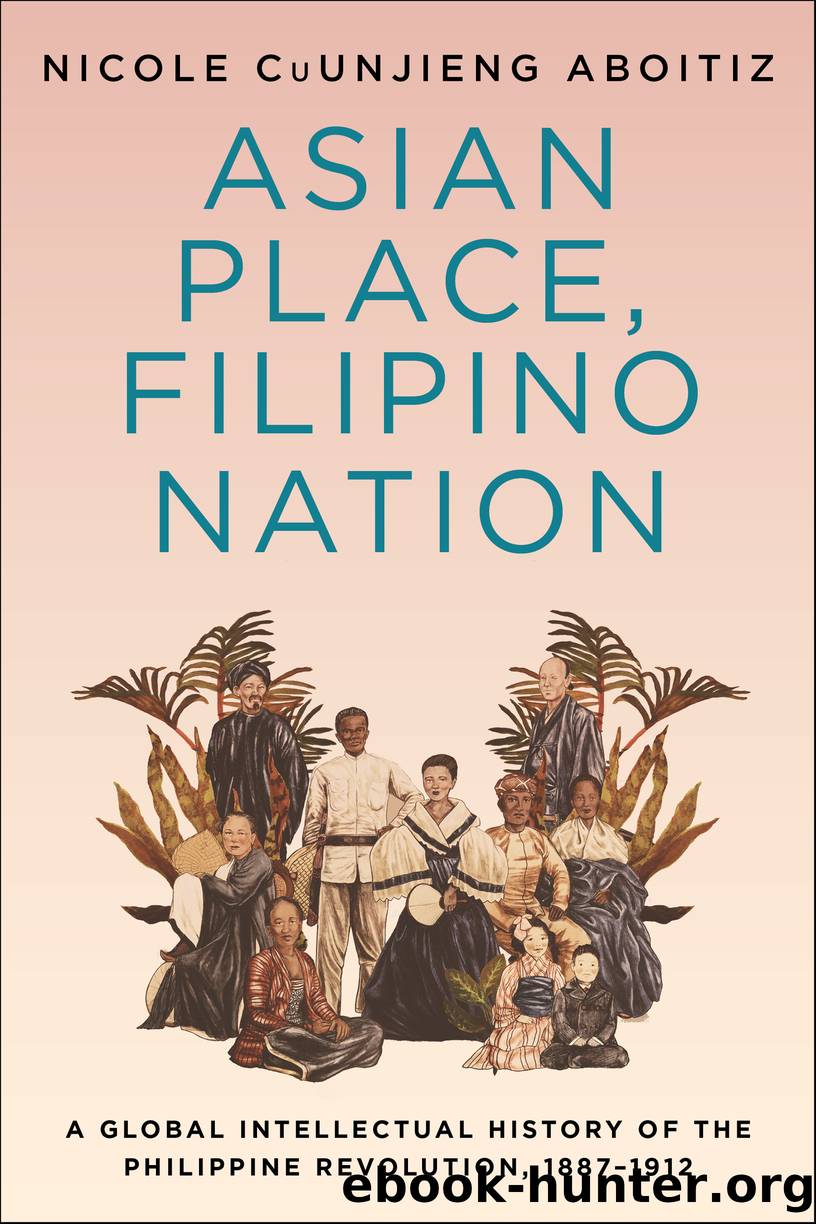
Author:Nicole CuUnjieng Aboitiz
Language: eng
Format: epub
Publisher: Columbia University Press
Ware Kono Uta Kono Namida
Kono Ai Ikade Hakumei no
Kishi wo Nagusame Ezaranya
Tamatama Kitare Kyokutō no
Asahi Shiworini Aginarudo.
How can I address this song
This tear and this love
To compensate the brilliant hero who died young
Rise, Aguinaldo, as the morning sun from the Far East.152
The cracks in the fantasies and hopes of Pan-Asianism, however, had already long begun to show, even theoretically. By November 3, 1899, a tired Apolinario Mabini had written to his friend Mr. Remontado, “If we have to believe in history, Alexander, Caesar and Napoleon tried the fusion of nations into one to establish a universal empire through conquest.”153 Mabini then went on to cite the despotic attempts of Roman kings in the Middle Ages and the Catholic conquests after Pope Alexander VI in 1493 offered these kings the whole globe. “Today, the great thinkers point out a universal federation as the most reasonable means of fusion,” he wrote, “but it seems that the great powers have a different opinion, as it is more advantageous to exploit the weak nations than to protect them with their alliance and friendship.”154 Therein lay the problem not only of imperialism and the kind of cosmopolitanism that Kant and other Enlightenment thinkers advocated, but also of Pan-Asianism. Mabini highlighted in this letter both the dream and the impossibility inherent in any kind of universalistic solidarity. “Undoubtedly, universal solidarity is the most efficient means to realize the highest aim of humanity. Philosophers consider it the essence of infinite progress or of the rising perfection of the rational being to the highest grade possible, but how can we accomplish it?”155 Mabini believed that, as long as certain nations accept domination while others agree to dominate or to allow others to do so, there can never be “solidarity” or “possible equilibrium.”156
Miyazaki Tōten, while promoting Japanese immigration to Siam as a means to “awaken” Asia toward liberation, did not see the condescension embedded in that strategy, but instead flattened such asymmetries of power and history, while remaining blind to the privileged position he nevertheless maintained for Japan within this flattening. He embarked upon establishing “a pilot farm for one harvest as a base for settlers” in Siam, thereby “setting up a model community” through the generosity of Thai Chao Phraya Surasakmontri’s donation of land and farm tools.157 With this donation, Miyazaki recounted: “Our vigor was renewed; we took off our Western clothes and shoes and wore undershirts and straw sandals; some of us led the water buffalo and the others guided the plows. We looked like farmers in an old Chinese painting.”158 Despite the “high” purpose, flattening of power, and erasure of historical difference effected in Miyazaki’s image of an old Chinese painting, this idealization remained naïve to its own power logic (and patronizing tone). Miyazaki’s collaborator, Suenaga Setsu,159 wrote a poem in Chinese from the same estate where they were building their model farm community, which began: “A thatched hut near the outer city wall, / Tilling and plowing, our purpose is high.” From here, he swiftly
Download
This site does not store any files on its server. We only index and link to content provided by other sites. Please contact the content providers to delete copyright contents if any and email us, we'll remove relevant links or contents immediately.
| Arms Control | Diplomacy |
| Security | Trades & Tariffs |
| Treaties | African |
| Asian | Australian & Oceanian |
| Canadian | Caribbean & Latin American |
| European | Middle Eastern |
| Russian & Former Soviet Union |
The Secret History by Donna Tartt(18973)
The Social Justice Warrior Handbook by Lisa De Pasquale(12172)
Thirteen Reasons Why by Jay Asher(8856)
This Is How You Lose Her by Junot Diaz(6845)
Weapons of Math Destruction by Cathy O'Neil(6229)
Zero to One by Peter Thiel(5743)
Beartown by Fredrik Backman(5691)
The Myth of the Strong Leader by Archie Brown(5474)
The Fire Next Time by James Baldwin(5398)
How Democracies Die by Steven Levitsky & Daniel Ziblatt(5183)
Promise Me, Dad by Joe Biden(5120)
Stone's Rules by Roger Stone(5060)
A Higher Loyalty: Truth, Lies, and Leadership by James Comey(4923)
100 Deadly Skills by Clint Emerson(4888)
Rise and Kill First by Ronen Bergman(4747)
Secrecy World by Jake Bernstein(4712)
The David Icke Guide to the Global Conspiracy (and how to end it) by David Icke(4664)
The Farm by Tom Rob Smith(4475)
The Doomsday Machine by Daniel Ellsberg(4463)
